Volume 13, Issue 2 (5-2025)
Jorjani Biomed J 2025, 13(2): 29-34 |
Back to browse issues page



Download citation:
BibTeX | RIS | EndNote | Medlars | ProCite | Reference Manager | RefWorks
Send citation to:


BibTeX | RIS | EndNote | Medlars | ProCite | Reference Manager | RefWorks
Send citation to:
Saadati M, Bagheri A. Predictors of the first marriage longevity of divorced women with children. Jorjani Biomed J 2025; 13 (2) :29-34
URL: http://goums.ac.ir/jorjanijournal/article-1-1074-en.html
URL: http://goums.ac.ir/jorjanijournal/article-1-1074-en.html


1- Department of Statistical Methods and Demographic Modelling, National Institute for Population Research, Tehran, Iran
2- Department of Statistical Methods and Demographic Modelling, National Institute for Population Research, Tehran, Iran ,arezoo.bagheri@nipr.ac.ir
2- Department of Statistical Methods and Demographic Modelling, National Institute for Population Research, Tehran, Iran ,
Full-Text [PDF 577 kb]
(3313 Downloads)
| Abstract (HTML) (11412 Views)
Discussion
The objective of the present study was to investigate the factors influencing FML among divorced women with children, based on selected covariates. The findings revealed that an increase in HDI led to a decrease in women’s FML. What makes the relationship between development and divorce significant is the secondary effects and consequences that development brings, which contribute to the rise in divorce rates in society. Longstreet et al. (2019), Valenzuela et al. (2014), and Deihoul et al. (2018) reported results consistent with the present study (14-16).
Many researchers have pointed to the direct relationship between education levels and divorce in Iran (17,18), and found that higher levels of education among women, as well as their participation in the labor force, significantly increased the likelihood of divorce. Contrary to these studies, the present study found that as the number of years of education increases, the FML also increases among divorced women with children (The risk of divorce decreases). In line with these results, Imanzadeh et al. (2021) and Sadeghi et al. (2018) concluded that if the growth of women's education and the expansion of higher education are accompanied by the creation of job opportunities, the possibility of increased family income arises, leading to a higher expected value of marital life and contributing to family stability and the survival of marriage (19,20).
Based on the results, as the age at marriage increases, women’s FML decreases (The risk of divorce increases). Logical and emotion-free behavior, spouses' concerns about such behaviors, the lack of necessary flexibility for spousal compromise, and the inevitable selection of spouses based on inappropriate criteria are among the most important reasons for the decline in marital survival among older women, which aligns with the findings of this study and is consistent with the research of Ghiasi et al. (2010) and Moltfat and Ahmadi (2008) (12,21). In the present study, as the spouses’ marriage age increased, the women’s FML decreased. Consistent with the results of this study, Imanzadeh et al. (2021) showed that an increase in the spouses’ marriage age elevated the risk of divorce by 1.22 times and reduced marital survival (19).
Interference or influence from the spouses' original families can be one of the underlying causes of conflicts from the beginning to the end of any marriage (22,23). The results of the present study revealed that the variables of the father's living status and the number of the spouse's siblings had a significant effect on the analysis of women’s FML. Consistent with this study, Imanzadeh et al. (2021) in their research identified large paternal families as one of the most important reasons for spousal satisfaction and compromise (19).
The number of children had a positive effect on women’s FML in this study. According to the findings of Ghiasi et al. (2010), women without children had a higher tendency toward divorce compared to women with three or more children (12). Sadeghi (2017) noted that the presence of children has selective and protective effects on divorce; young couples who are still uncertain about the stability of their lives do not have children and delay having them (Selective effect), and on the other hand, having children deters couples from pursuing divorce (Protective effect) (24). The negative relationship between the number of children and the risk of divorce has also been confirmed in studies conducted in other countries (25,26). Hewitt’s (2008) study in Australia showed that the likelihood of divorce is inversely related to having children (26). Bernardi and Martin-Pastor’s (2001) study in Spain indicated that having children reduces the probability and risk of divorce among couples (27).
As the age of the first child of divorced women increased, their FML decreased. Zhian et al. (2015) noted that the impact of children on marital stability varies based on their gender and age (28). Steel et al. (2005) found that preschool-aged children have a stabilizing effect on the lives of married or cohabiting parents, but this effect weakens for older children. As children grow older, they are more likely to provide financial and economic support, enabling parents to establish an independent life after divorce (29). On the other hand, couples are concerned about their children and societal perceptions regarding children of divorce, stepfathers, and stepmothers, leading them to endure conflicts for years to avoid harming their children. They often pursue divorce only after their children have grown up (30).
One of the fundamental challenges for couples with children during divorce is child custody. The findings of Rezazadeh et al. (2018) revealed that one of the factors influencing divorce in the final stages of marital life is child custody (31). In the present study, in most cases, women had taken custody of their children (53.2%), while the spouses of 33.1% of the women had custody. The results showed that, when the woman had custody of the children, her FML was longer compared to when other individuals (Parents and relatives of the couple) had this responsibility.
Conclusion
According to the findings of this study, it can be concluded that the presence of children in the family affects the longevity of women’s marriage; by increasing the number of children, the risk of divorce is reduced. On the other hand, as the age of women’s first child increased, the women’s marriage longevity decreased. This result is in line with previous studies, which confirmed that children can play positive or negative roles in women’s divorce.
Acknowledgement
None.
Funding sources
The present study was extracted from a thesis entitled “Random Survival Forest of Childless and with Children Women’s First Marriage Survival”, supported by the National Institute for Population Research in 2022, with registered number 21/110678.
Ethical statement
Since no intervention was used in this survey and the questionnaires were filled out with the participants' consent, there was no requirement for an ethical code.
Conflicts of interest
The authors declared no conflict of interest.
Author contributions
All authors participated in the design, implementation, and writing of all sections of the present study.
Data availability statement
The data for this study was gathered through a national survey conducted by the Civil Registration Organization, and it is only available to authorized individuals.
Full-Text: (1316 Views)
Introduction
Today, divorce, as one of the manifestations of global modernization, has grown in almost all countries. Statistics show that crude divorce rates increased in all OECD members between 1970 and 2017 (1). Over the past decade, divorce has faced Iranian society with challenges. According to the National Civil Registration Organization in 2024, 194,078 divorces were recorded compared with 176,890 divorces in 2014, showing an increased divorce rate (2). Kargar et al. (2023) followed up 770,000 couples who started their marriage in 2012 over a 10-year period; based on the results, 15.1% of these marriages had ended by January 2021 (3).
Divorce, as an important social harm, causes financial, emotional, physical, and legal challenges in couples (4). It is a significant phenomenon affecting the continuation of the young population in both quantity and quality; it breaks up the only legitimate and basic unit of reproduction, the family, and also causes children deprived of family support to be handed over to society (5). Marriage Longevity (The length of marriage until the divorce) is one of the demographic indicators of divorce; the decrease in duration of marriage is worrying and appropriate attention is needed (6). The mean marriage longevity was 9.2 years in Iran in 2019. In 2022, 32.1% of divorces occurred within the first five years of marriage; 9.5%, 14.1%, and 20.8% of divorces were related to marriages of less than a year, up to two years, and up to three years of marriage, respectively (7). In overcoming this situation, finding the risk factors of marriage longevity would be beneficial for better education of new couples and planning. Recently, researchers have been interested in studying marriage longevity in Iran by different methods. Mahdavi et al. (2013) investigated the role of selected variables in the marriage stability of 386 married people in Tabriz, utilizing discriminant analysis. Findings indicate that marriage survival determinants include participation, coherence, satisfaction, homogamy, independence, power, intimacy, stability (childbearing), and stratification (8). Norouzi et al. (2022) utilized competing risks survival analysis of 386 individuals who were married and divorced from 1991 to 2017 to investigate the marriage survival of new couples in Tabriz. The results of multivariate Lunn-McNeil models indicated that for the competing cause of having a relationship with another person, the traditional mode of being familiar, family weak role in choosing a wife/spouse, and the role of moral-religious commitment, along with other causes, exacerbated the risk of marriage survival reduction (4). Khoundabi et al. (2025) investigated the chance of leaving married life using Cox proportional hazard models with random effects, estimating the influence of demographic variables such as age at marriage, gender, place of residence, and province (6). Bagheri and Saadati (2024) examined the most important determinants of the first marriage survival of women using survival forests (9).
Having children as a deterrent to divorce can influence the inclination toward it. The cost of divorce, which refers to the greater difficulty of remarriage for divorced women, is higher for women with children (10). Since women with children often have a special attachment to their children, this has led them to endure marital difficulties as much as possible and avoid separation and divorce for the sake of their children, continuing their marital life (11). The emotional bond between the child and the mother reduces the tendency toward divorce (12). With the arrival of the first child in the family, couples take on another role, and since women fulfill some of their needs through their children in this situation, they feel less of a sense of loss, and their inclination toward divorce decreases. In order to increase marriage duration, it is necessary and advisable to identify the factors affecting marriage longevity that can help investigators and policymakers to provide solutions for reducing the divorce rate. Therefore, the present study aimed to examine the determinants of First Marriage Longevity (FML) among divorced women with children using unshared frailty models based on selected covariates.
Methods
In this study, 756 divorced women with children, whose information was collected during the first wave of the marriage and divorce survey -a cross-sectional study conducted by the National Organization for Civil Registration in autumn 2017-2018- were considered. The FML (Interval between marriage and divorce) of these women was analyzed based on macro-level provincial factors (Human development index and married divorce rate), factors related to women themselves (Number of siblings, educational years, and marriage age), family-related factors (Father’s educational years, mother’s educational years, father’s living status, and mother’s living status), factors related to the spouse (Number of siblings, marriage age, and educational years), factors related to the spouse’s family (Father’s educational years and mother’s educational years), marriage-related factors (Years of informal acquaintance), divorce-related factors (Emotional divorce and residence after divorce), women’s time-use factors (Hours spent on visiting relatives, hours spent on learning activities, hours spent with spouse, and hours spent on cultural activities), and children related factors (Number of children, first child’s age, child’s custody status, and provider of child expenses during custody) covariates (9) by unshared frailty models utilizing SAS software.
When the aim of the study is to analyze time-to-event data, survival analysis methods are used; the most commonly applied survival model is the Cox Proportional Hazards (CPH) and parametric Accelerated Failure Time (AFT) models. When there exists variability due to unobserved individual-level factors, these common survival models lead to overestimated model parameters by ignoring individual effects. In this condition, a random component is used to express these unknown factors, which are called frailty in survival analysis. Frailty is a random component designed to account for variability due to unobserved individual-level factors that are not explained by the other predictors in the model. Shared and unshared frailty models are two common types of this model used to analyze survival data. For unshared frailty models, a subject’s survival is assumed to be independent of the survival of other subjects in the study population. For shared frailty models, however, the frailty accounts for dependence among subjects who share the same frailty. Shared frailty provides an approach to account for correlation in the data due to unobservable factors common within clusters of subjects (13).
Results
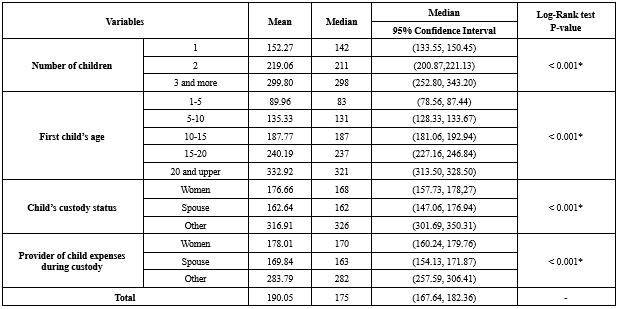
Table 1 represents the covariates’ frequency percentage, and Table 2 shows Kaplan-Meier estimates and Log-Rank test for divorced women’s FML based on children-related covariates.
Today, divorce, as one of the manifestations of global modernization, has grown in almost all countries. Statistics show that crude divorce rates increased in all OECD members between 1970 and 2017 (1). Over the past decade, divorce has faced Iranian society with challenges. According to the National Civil Registration Organization in 2024, 194,078 divorces were recorded compared with 176,890 divorces in 2014, showing an increased divorce rate (2). Kargar et al. (2023) followed up 770,000 couples who started their marriage in 2012 over a 10-year period; based on the results, 15.1% of these marriages had ended by January 2021 (3).
Divorce, as an important social harm, causes financial, emotional, physical, and legal challenges in couples (4). It is a significant phenomenon affecting the continuation of the young population in both quantity and quality; it breaks up the only legitimate and basic unit of reproduction, the family, and also causes children deprived of family support to be handed over to society (5). Marriage Longevity (The length of marriage until the divorce) is one of the demographic indicators of divorce; the decrease in duration of marriage is worrying and appropriate attention is needed (6). The mean marriage longevity was 9.2 years in Iran in 2019. In 2022, 32.1% of divorces occurred within the first five years of marriage; 9.5%, 14.1%, and 20.8% of divorces were related to marriages of less than a year, up to two years, and up to three years of marriage, respectively (7). In overcoming this situation, finding the risk factors of marriage longevity would be beneficial for better education of new couples and planning. Recently, researchers have been interested in studying marriage longevity in Iran by different methods. Mahdavi et al. (2013) investigated the role of selected variables in the marriage stability of 386 married people in Tabriz, utilizing discriminant analysis. Findings indicate that marriage survival determinants include participation, coherence, satisfaction, homogamy, independence, power, intimacy, stability (childbearing), and stratification (8). Norouzi et al. (2022) utilized competing risks survival analysis of 386 individuals who were married and divorced from 1991 to 2017 to investigate the marriage survival of new couples in Tabriz. The results of multivariate Lunn-McNeil models indicated that for the competing cause of having a relationship with another person, the traditional mode of being familiar, family weak role in choosing a wife/spouse, and the role of moral-religious commitment, along with other causes, exacerbated the risk of marriage survival reduction (4). Khoundabi et al. (2025) investigated the chance of leaving married life using Cox proportional hazard models with random effects, estimating the influence of demographic variables such as age at marriage, gender, place of residence, and province (6). Bagheri and Saadati (2024) examined the most important determinants of the first marriage survival of women using survival forests (9).
Having children as a deterrent to divorce can influence the inclination toward it. The cost of divorce, which refers to the greater difficulty of remarriage for divorced women, is higher for women with children (10). Since women with children often have a special attachment to their children, this has led them to endure marital difficulties as much as possible and avoid separation and divorce for the sake of their children, continuing their marital life (11). The emotional bond between the child and the mother reduces the tendency toward divorce (12). With the arrival of the first child in the family, couples take on another role, and since women fulfill some of their needs through their children in this situation, they feel less of a sense of loss, and their inclination toward divorce decreases. In order to increase marriage duration, it is necessary and advisable to identify the factors affecting marriage longevity that can help investigators and policymakers to provide solutions for reducing the divorce rate. Therefore, the present study aimed to examine the determinants of First Marriage Longevity (FML) among divorced women with children using unshared frailty models based on selected covariates.
Methods
In this study, 756 divorced women with children, whose information was collected during the first wave of the marriage and divorce survey -a cross-sectional study conducted by the National Organization for Civil Registration in autumn 2017-2018- were considered. The FML (Interval between marriage and divorce) of these women was analyzed based on macro-level provincial factors (Human development index and married divorce rate), factors related to women themselves (Number of siblings, educational years, and marriage age), family-related factors (Father’s educational years, mother’s educational years, father’s living status, and mother’s living status), factors related to the spouse (Number of siblings, marriage age, and educational years), factors related to the spouse’s family (Father’s educational years and mother’s educational years), marriage-related factors (Years of informal acquaintance), divorce-related factors (Emotional divorce and residence after divorce), women’s time-use factors (Hours spent on visiting relatives, hours spent on learning activities, hours spent with spouse, and hours spent on cultural activities), and children related factors (Number of children, first child’s age, child’s custody status, and provider of child expenses during custody) covariates (9) by unshared frailty models utilizing SAS software.
When the aim of the study is to analyze time-to-event data, survival analysis methods are used; the most commonly applied survival model is the Cox Proportional Hazards (CPH) and parametric Accelerated Failure Time (AFT) models. When there exists variability due to unobserved individual-level factors, these common survival models lead to overestimated model parameters by ignoring individual effects. In this condition, a random component is used to express these unknown factors, which are called frailty in survival analysis. Frailty is a random component designed to account for variability due to unobserved individual-level factors that are not explained by the other predictors in the model. Shared and unshared frailty models are two common types of this model used to analyze survival data. For unshared frailty models, a subject’s survival is assumed to be independent of the survival of other subjects in the study population. For shared frailty models, however, the frailty accounts for dependence among subjects who share the same frailty. Shared frailty provides an approach to account for correlation in the data due to unobservable factors common within clusters of subjects (13).
Results
Table 1 represents the covariates’ frequency percentage, and Table 2 shows Kaplan-Meier estimates and Log-Rank test for divorced women’s FML based on children-related covariates.
|
Table 1. Frequency distribution of selected covariates *
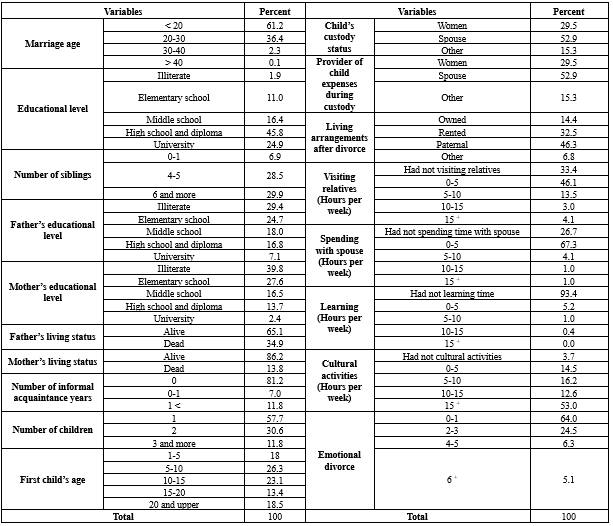 * Due to missing values, the total frequency of some variables is less than 100. |
|
Table 2. Kaplan-Meier estimates and Log-Rank test for divorced women FML based on children-related covariates
 |
Based on the results, 57.7%, 30.6%, and 11.8% of women had one, two, and three or more children, respectively; most of the children were 10 years old or older (55%), their custody was with their mothers (53.2%), and their fathers provided their expenses (52.9%). The estimated median of FML for divorced women with children was 175 months (±7.36 months), meaning that 50% of them had FML of 14.58 years.
As Table 2 shows, Kaplan-Meier estimates of FML were significantly different among categories of number of children, first child’s age, child’s custody status, and provider of child expenses during custody (P-Value <0.001); as the number of children and the age of the first child increased, women’s FML also increased. On the other hand, women whose spouses had their children’s custody and expenses had the shortest FMLs.
To analyze the data, AFT models, including exponential, Weibull, log-logistic, log-normal, and generalized gamma models, were fitted on women’s FML based on selected covariates. Akaike information criteria (AIC) and Bayesian information criteria (BIC) were considered indices for examining the most efficient model; both criteria suggested that Weibull AFT model must be chosen as the final model. To test the significance of individual dispersion in data, an unshared frailty Weibull model with gamma and inverse Gaussian distributions was also fitted to the data.
Table 3 shows the estimated values of the frailty distribution variance(θ), the p-value of the log(θ) test, the log-likelihood, and AIC and BIC of this model. Based on the likelihood-ratio test in this table, unshared frailty variance was significant for both models (P-Value < 0.001), indicating sufficient dispersion for the variance of unshared frailty, so frailty should be considered in this model for analyzing FML of divorced women with children. Based on the values of the frailty distribution variance (Largest) and the AIC and BIC (Smallest), the unshared frailty Weibull model with gamma distribution was selected as the final model for analyzing data.
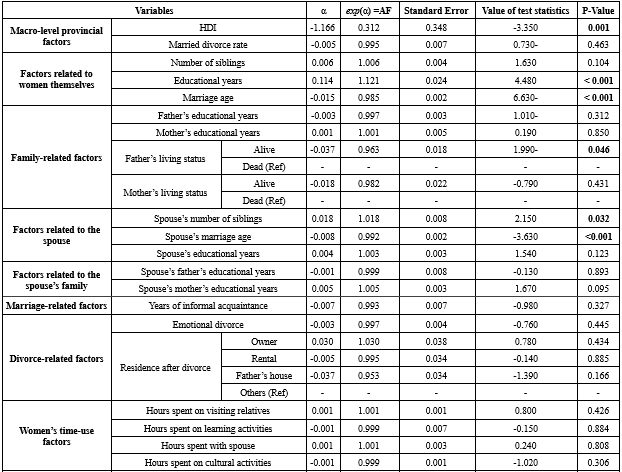
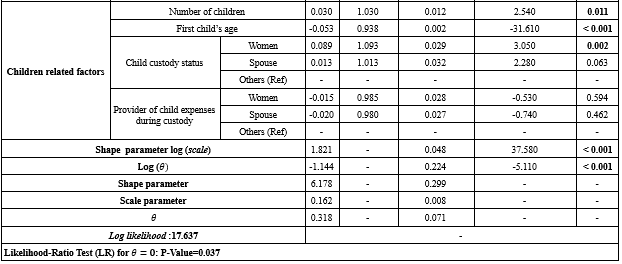
Table 4 shows the results of fitting this model. The shape parameter in the model was estimated to be 6.178, indicating that the hazard of divorce for women who had the same individual characteristics increases over time. Based on the Accelerate Factor (AF) columns in this table, the following interpretations from significant covariates for divorced women with children who had the same individual characteristics can be derived as follows:
As Table 2 shows, Kaplan-Meier estimates of FML were significantly different among categories of number of children, first child’s age, child’s custody status, and provider of child expenses during custody (P-Value <0.001); as the number of children and the age of the first child increased, women’s FML also increased. On the other hand, women whose spouses had their children’s custody and expenses had the shortest FMLs.
To analyze the data, AFT models, including exponential, Weibull, log-logistic, log-normal, and generalized gamma models, were fitted on women’s FML based on selected covariates. Akaike information criteria (AIC) and Bayesian information criteria (BIC) were considered indices for examining the most efficient model; both criteria suggested that Weibull AFT model must be chosen as the final model. To test the significance of individual dispersion in data, an unshared frailty Weibull model with gamma and inverse Gaussian distributions was also fitted to the data.
Table 3 shows the estimated values of the frailty distribution variance(θ), the p-value of the log(θ) test, the log-likelihood, and AIC and BIC of this model. Based on the likelihood-ratio test in this table, unshared frailty variance was significant for both models (P-Value < 0.001), indicating sufficient dispersion for the variance of unshared frailty, so frailty should be considered in this model for analyzing FML of divorced women with children. Based on the values of the frailty distribution variance (Largest) and the AIC and BIC (Smallest), the unshared frailty Weibull model with gamma distribution was selected as the final model for analyzing data.
Table 4 shows the results of fitting this model. The shape parameter in the model was estimated to be 6.178, indicating that the hazard of divorce for women who had the same individual characteristics increases over time. Based on the Accelerate Factor (AF) columns in this table, the following interpretations from significant covariates for divorced women with children who had the same individual characteristics can be derived as follows:
- It can be concluded that as the Human Development Index (HDI) of divorced women increases, these women divorce 0.312 times sooner; in other words, they have a shorter FML.
- As the number of years of education of divorced women increases, these women divorce 1.121 times later; in other words, they have a longer FML.
- As the marriage age of divorced women increases, they divorce 0.985 times sooner; therefore, they have a shorter FML.
- It can be concluded that divorced women whose fathers were alive divorced 0.963 times sooner compared with those whose fathers were death.
- As the number of spouses' siblings of divorced women increases, these women divorce 1.018 times later; in other words, they have a longer FML.
- It can be concluded that as the spouse's marriage age of divorced women increases, these women divorce 0.992 times sooner.
- It can be concluded that as the number of children of divorced women increases, these women divorce 1.030 times later.
- As the age of the first child of divorced women increases, these women divorce 0.938 times sooner; in other words, they have a shorter survival of their first marriage.
For the child’s custody status (Woman) variable, it can be concluded that women who had custody of their children after divorce divorced 1.093 times later, compared with those whose custody was held by others.
|
Table 3. Estimation of frailty distribution variance (θ) and goodness-of-fit criteria for unshared frailty weibull AFT model in the analysis of the FML of divorced women with children
 *Significance at 0.01 |
|
Table 4. Results of fitting unshared frailty weibull model with gamma distribution for analyzing FML based on selected covariates
  |
Discussion
The objective of the present study was to investigate the factors influencing FML among divorced women with children, based on selected covariates. The findings revealed that an increase in HDI led to a decrease in women’s FML. What makes the relationship between development and divorce significant is the secondary effects and consequences that development brings, which contribute to the rise in divorce rates in society. Longstreet et al. (2019), Valenzuela et al. (2014), and Deihoul et al. (2018) reported results consistent with the present study (14-16).
Many researchers have pointed to the direct relationship between education levels and divorce in Iran (17,18), and found that higher levels of education among women, as well as their participation in the labor force, significantly increased the likelihood of divorce. Contrary to these studies, the present study found that as the number of years of education increases, the FML also increases among divorced women with children (The risk of divorce decreases). In line with these results, Imanzadeh et al. (2021) and Sadeghi et al. (2018) concluded that if the growth of women's education and the expansion of higher education are accompanied by the creation of job opportunities, the possibility of increased family income arises, leading to a higher expected value of marital life and contributing to family stability and the survival of marriage (19,20).
Based on the results, as the age at marriage increases, women’s FML decreases (The risk of divorce increases). Logical and emotion-free behavior, spouses' concerns about such behaviors, the lack of necessary flexibility for spousal compromise, and the inevitable selection of spouses based on inappropriate criteria are among the most important reasons for the decline in marital survival among older women, which aligns with the findings of this study and is consistent with the research of Ghiasi et al. (2010) and Moltfat and Ahmadi (2008) (12,21). In the present study, as the spouses’ marriage age increased, the women’s FML decreased. Consistent with the results of this study, Imanzadeh et al. (2021) showed that an increase in the spouses’ marriage age elevated the risk of divorce by 1.22 times and reduced marital survival (19).
Interference or influence from the spouses' original families can be one of the underlying causes of conflicts from the beginning to the end of any marriage (22,23). The results of the present study revealed that the variables of the father's living status and the number of the spouse's siblings had a significant effect on the analysis of women’s FML. Consistent with this study, Imanzadeh et al. (2021) in their research identified large paternal families as one of the most important reasons for spousal satisfaction and compromise (19).
The number of children had a positive effect on women’s FML in this study. According to the findings of Ghiasi et al. (2010), women without children had a higher tendency toward divorce compared to women with three or more children (12). Sadeghi (2017) noted that the presence of children has selective and protective effects on divorce; young couples who are still uncertain about the stability of their lives do not have children and delay having them (Selective effect), and on the other hand, having children deters couples from pursuing divorce (Protective effect) (24). The negative relationship between the number of children and the risk of divorce has also been confirmed in studies conducted in other countries (25,26). Hewitt’s (2008) study in Australia showed that the likelihood of divorce is inversely related to having children (26). Bernardi and Martin-Pastor’s (2001) study in Spain indicated that having children reduces the probability and risk of divorce among couples (27).
As the age of the first child of divorced women increased, their FML decreased. Zhian et al. (2015) noted that the impact of children on marital stability varies based on their gender and age (28). Steel et al. (2005) found that preschool-aged children have a stabilizing effect on the lives of married or cohabiting parents, but this effect weakens for older children. As children grow older, they are more likely to provide financial and economic support, enabling parents to establish an independent life after divorce (29). On the other hand, couples are concerned about their children and societal perceptions regarding children of divorce, stepfathers, and stepmothers, leading them to endure conflicts for years to avoid harming their children. They often pursue divorce only after their children have grown up (30).
One of the fundamental challenges for couples with children during divorce is child custody. The findings of Rezazadeh et al. (2018) revealed that one of the factors influencing divorce in the final stages of marital life is child custody (31). In the present study, in most cases, women had taken custody of their children (53.2%), while the spouses of 33.1% of the women had custody. The results showed that, when the woman had custody of the children, her FML was longer compared to when other individuals (Parents and relatives of the couple) had this responsibility.
Conclusion
According to the findings of this study, it can be concluded that the presence of children in the family affects the longevity of women’s marriage; by increasing the number of children, the risk of divorce is reduced. On the other hand, as the age of women’s first child increased, the women’s marriage longevity decreased. This result is in line with previous studies, which confirmed that children can play positive or negative roles in women’s divorce.
Acknowledgement
None.
Funding sources
The present study was extracted from a thesis entitled “Random Survival Forest of Childless and with Children Women’s First Marriage Survival”, supported by the National Institute for Population Research in 2022, with registered number 21/110678.
Ethical statement
Since no intervention was used in this survey and the questionnaires were filled out with the participants' consent, there was no requirement for an ethical code.
Conflicts of interest
The authors declared no conflict of interest.
Author contributions
All authors participated in the design, implementation, and writing of all sections of the present study.
Data availability statement
The data for this study was gathered through a national survey conducted by the Civil Registration Organization, and it is only available to authorized individuals.
Editorial: Original article |
Subject:
Bio-statistics
Received: 2025/04/6 | Accepted: 2025/06/1 | Published: 2025/06/18
Received: 2025/04/6 | Accepted: 2025/06/1 | Published: 2025/06/18
References
1. Fostik A, Fernández Soto M, Ruiz-Vallejo F, Ciganda D. :union:: instability and fertility: An international perspective. Eur J Popul. 2023;39(1):25. [View at Publisher] [DOI] [PMID] [Google Scholar]
2. Statistical Center of Iran. Economic and Social Key Indicators of Iran September 2025. Tehran. Statistical Center of Iran Publisher. 2025. P. 26. Available from: https://amar.org.ir/statistical-information/statid/55572 [View at Publisher]
3. Kargar H, Sajedi A, Omidvar S. A longitudinal study of childbearing pattern in the couple married in in 2013. Population Journal. 2023;119(120):1-22. [View at Publisher]
4. Norouzi S, Tamiz R, Naghizadeh S, Mobasseri K, Imani L, Esmaeili P, et al. Marriage survival in new married couples: A competing risks survival analysis. PLoS One. 2022;17(8):e0272908. [View at Publisher] [DOI] [PMID] [Google Scholar]
5. Fathi- Ashtiani A, Amiri S, Fathi Ashtiani M, sedghi Jalal A, Nicknam MH, Noorbala AA, et al. Effective factors on divorce in the past 10 years in Iran. Iran J Cult Health Promot. 2023;7(2):289-302. [View at Publisher] [DOI] [Google Scholar]
6. Khoundabi B, Banihashemi FS, Alimondegari M. Determinants of survival time in Married life in iran. Journal of Population Association of Iran. 2025;19(38):223-57. [View at Publisher] [DOI] [Google Scholar]
7. National Organization for Civil Registration. Demographic statistics yearbook 2022. Tehran: National Organization for Civil Registration Publications (2023). [View at Publisher]
8. Mahdavi MS,Tamiz R. Sociological discriminant analysis of Hemphill's index in marriage survival (case study of Tabriz). JISDS. 2013;5(2):55-74. [View at Publisher] [Google Scholar]
9. Bagheri A, Saadati M. The application of survival forests in the study of the most important determinants of the first marriage survival of divorced women with children. Payesh. 2024;23(5):759-69. [View at Publisher] [DOI] [Google Scholar]
10. Wang Q, Zhou Q. China's divorce and remarriage rates: trends and regional disparities. Journal of Divorce & Remarriage. 2010;51:257-67. [View at Publisher] [DOI] [Google Scholar]
11. Sarokhani B. Divorce: A study on understanding its reality and factors. Tehran: University of Tehran Press. 1997. [View at Publisher]
12. Ghiasi P, Moein L, Rousta L. AN ANALYSIS OF THE SOCIAL FACTORS LEADING TO DIVORCE PETITIONS AMONG WOMEN REFERRING TO FAMILY COURTS IN SHIRAZ. Journal of Women's Sociology. 2010;1(3):77-103. [View at Publisher] [Google Scholar]
13. Klein JP, Moeschberger ML: Survival Analysis: techniques for censored and truncated Data. New York: Springer Science & Business Media; 2006. [View at Publisher] [Google Scholar]
14. Longstreet P, Brooks S, Gonzalez E. S. Internet addiction: When the positive emotions are not so positive. Technology in Society. 2019;57:76-85. [View at Publisher] [DOI] [Google Scholar]
15. Valenzuela S, Halpern D, Katz JE. Social network sites, marriage well-being and divorce: Survey and state-level evidence from the United States. Computers in Hum Behavior. 2014;36:94-101. [View at Publisher] [DOI] [Google Scholar]
16. Deihoul M, Ahmadi S, Mirfardi A. The relationship between development and divorce in Iran. Soc Work Res. 2019;9(3):180-217. [View at Publisher] [DOI] [Google Scholar]
17. Deldar F, Fallahi MA. Investigating the factors affecting divorce in Iran's provinces with an emphasis on economic factors. Journal of Women and Family's Cultural and Educational. 2016;10(34):135-54. [View at Publisher] [Google Scholar]
18. Chaboki E. An intergenerational study of the relationship between attitudes toward divorce and family functions in women Of Tehran. Journal of Women and Family Studies. 2013;1(1):159-85. [View at Publisher] [Google Scholar]
19. Imanzadeh V, Moheb N, Abdi R, Honarmand Azimi M. Identifying Effective Factors on Divorce and Providing a Model for Divorce Prediction Using Modelling of a Data Mining Decision Tree. Applied Psychological Research Quarterly. 2021;12(2):247-63. [View at Publisher] [DOI] [Google Scholar]
20. Sadeghi R, Zanjari N, Mahmoudiani S. TMarriage Patterns, Marital Satisfaction, and Tendency to Divorce in Tehran City. Journal of Women and Family's Cultural and Social Council. 2018;21(81):7-45. [View at Publisher] [DOI] [Google Scholar]
21. Moltfat H, Ahmadi H. Investigating factors influencing couples' tendency toward divorce: A case study of Darab County. Population Association Journal. 2008;3(5):152-68. [View at Publisher]
22. Zarean M. Meta-analysis of factors affecting divorce: A review of studies recorded in the last decade. QJCR. 2017;16(61):135-49. [View at Publisher] [Google Scholar]
23. Hoseini F, Rezapoor M, Saatloo ME. The Study of Effective Factors in Increasing Divorce Rate (Case Study: Divorced Couples of Sarpolezahab Town). Quarterly journal of social work. 2015;4(2);33-41 [View at Publisher] [Google Scholar]
24. Sadeghi R. Socioeconomic factors affecting Iranian youth divorce. Strategic Studies on Youth and Sports. 2017;15(32):189-205. [View at Publisher] [Google Scholar]
25. Coppola L, Cesare MD. How fertility and :union:: stability interact in shaping new family patterns in Italy and Spain. Demogr Res. 2008;18(4):117-44. [View at Publisher] [DOI] [Google Scholar]
26. Hewitt B. Marriage breakdown in Australia: Social correlates, gender and initiator status. Social Policy Research. 2008; Paper No. 35. [View at Publisher] [DOI] [Google Scholar]
27. Bernardi F, Martin-Pastor J. I. Divorce risk factors and their variations over time in Spain. Demogr Res. 2001;24(31):771-800. [View at Publisher] [DOI] [Google Scholar]
28. Zhian F, Navabinejad S, Azimi Garoosi S. Sexual satisfaction and marital adjustment among consanguineous and nonconsanguineous teaching couples. QJFR. 2015;12(2):27-40. [View at Publisher] [DOI] [Google Scholar]
29. Steele F, Kallis C, Goldstein H, Joshi H. The Relationship between childbearing and transitions from marriage and cohabitation in Britain. Demography. 2005;42(4):647-73. [View at Publisher] [DOI] [Google Scholar]
30. Lyngstad TH, Jalovaara M. A Review of the Antecedents of :union: Dissolution. Demogr Res. 2010;23:257-92. [View at Publisher] [DOI] [Google Scholar]
31. Rezazadeh SM, Bahrami Ehsan H, Fazel M, Fallah M. Investigating contextual factors and causes affecting divorce: An exploratory analysis. Psychological Sciences. 2018;7(71):765-74. [View at Publisher]
Send email to the article author
| Rights and permissions | |
 |
This work is licensed under a Creative Commons Attribution-NonCommercial 4.0 International License. |